Almost nothing in fertility attracts as much advice as diet, and almost none of that advice comes with evidence attached. People trying to conceive are offered elimination diets, expensive supplements, detox regimes and confident rules from every direction, most of it invented.
The genuinely useful list is short, which is good news — it means the effort can go where it counts. For a wider checklist, see planning a pregnancy.
Weight, and the Indian thresholds
Body weight affects fertility at both extremes, and the mechanism is hormonal rather than mysterious. Fat tissue produces oestrogen; too much or too little disturbs the signalling that drives ovulation.
What is important locally is that India uses lower BMI thresholds than international standards, because South Asian populations develop insulin resistance and metabolic complications at lower body weights. By these criteria, overweight begins at a BMI of 23 rather than 25. A BMI of 24 that would be called normal elsewhere is already above the healthy range here.
Where BMI is raised, a reduction of five to ten per cent of body weight improves ovulation, improves response to fertility medicines, and improves outcomes in pregnancy. That is a modest, achievable target — not a transformation.
A very low BMI matters too, and is discussed less. Below about 18.5, ovulation frequently stops altogether.
What the evidence actually supports
A Mediterranean-style pattern of eating
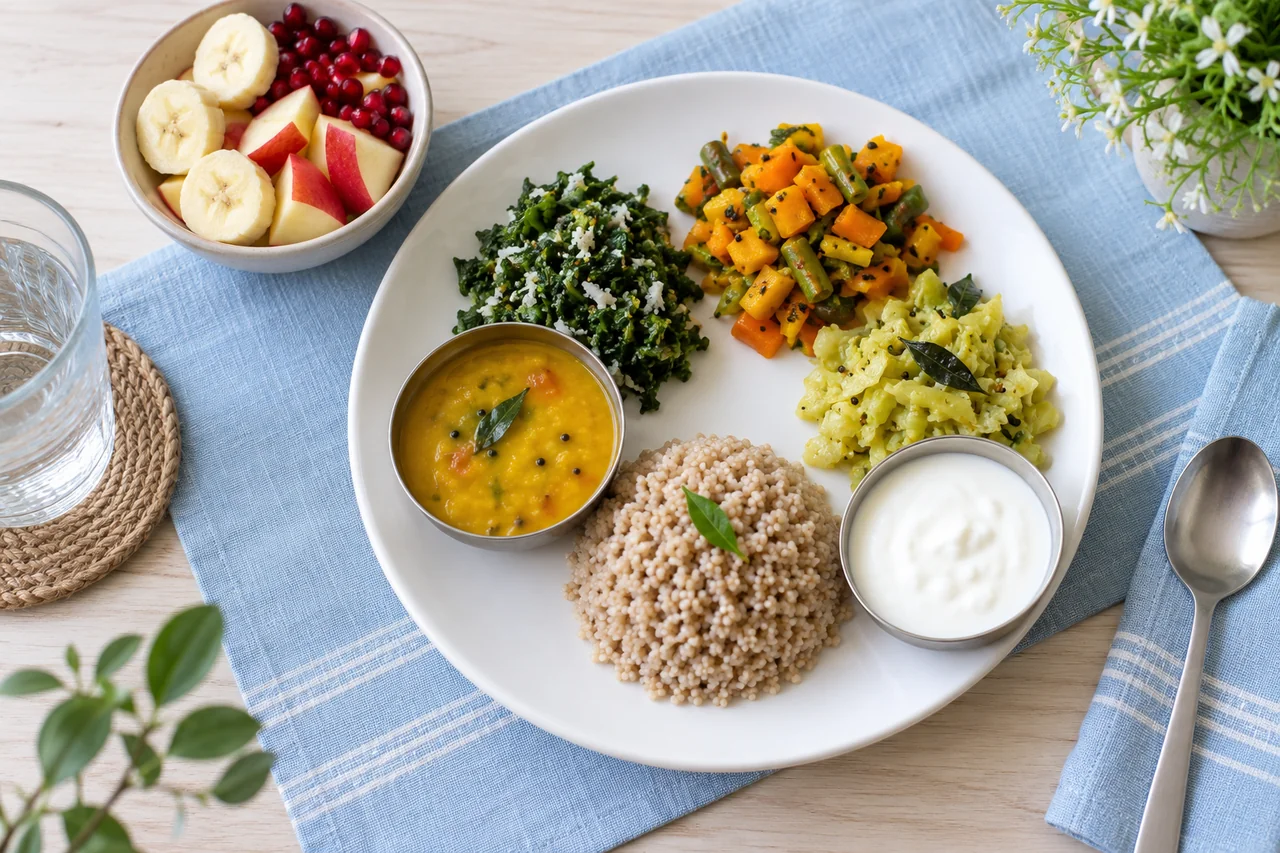
The dietary pattern with the most supportive evidence: vegetables, fruit, whole grains, pulses, nuts, olive oil, fish, with limited processed and red meat. It is worth saying that this maps comfortably onto traditional Indian vegetarian eating — dal, vegetables, whole grains, curd — and does not require importing anything.
Folic acid
Not a fertility treatment, but essential. Start at least a month before trying to conceive, to reduce the risk of neural tube defects. This is one of the clearest recommendations in the whole of reproductive medicine.
Vitamin D
Deficiency is very common in India, including among people who spend time outdoors, and has been associated with poorer fertility outcomes. Worth testing and correcting if low. Worth noting that correcting a deficiency is well supported; supplementing when you are not deficient is not.
Iron and B12
Anaemia is common, particularly in women, and B12 deficiency is common in vegetarians. Both are worth checking and correcting — for pregnancy and for general health.
Reducing trans fats and refined carbohydrate
Associated with better ovulatory function, and particularly relevant where there is insulin resistance or PCOS. Our article on PCOS and fertility explains why.
What is not supported
Most fertility supplements. The market is large and the evidence is thin. Correcting a documented deficiency helps. Taking a proprietary blend because it is marketed to people trying to conceive does not.
Elimination diets without a diagnosis. Cutting out gluten or dairy without coeliac disease or intolerance has no established fertility benefit, and makes eating well harder.
Detox programmes. There is no mechanism by which these affect fertility.
Alkaline diets, superfood protocols and "fertility teas". No credible evidence.
Extreme restriction. Actively harmful. Severe calorie restriction suppresses ovulation, which is the opposite of the goal.
Things that matter more than diet
- Stopping smoking and tobacco — the single most effective lifestyle change for both partners, with a clearer effect than any dietary intervention
- Reducing alcohol
- Sleep — poor and irregular sleep disturbs the hormonal rhythms that regulate cycles
- Regular moderate exercise — improves insulin sensitivity even without weight change
- Treating existing conditions — thyroid disease, diabetes and untreated infection affect fertility more than any food does
A note on how this is discussed
People trying to conceive are frequently told to relax, eat better and lose weight, in a tone suggesting the difficulty is their fault. It usually is not. Fertility problems are overwhelmingly medical — blocked tubes, absent ovulation, sperm problems, endometriosis — and no amount of dietary virtue addresses those.
Eating well and reaching a healthy weight are worth doing because they modestly improve your odds and are good for the pregnancy that follows. They are not a substitute for finding out what is actually wrong, and they are not a moral test.
Please note. This page is general information, not medical advice. What is appropriate for you depends on your history, your investigations and a specialist assessment. No fertility treatment can guarantee a pregnancy.
Reviewed by the clinical team at Sree Nandaka IVF Centre, Kompally. General information only — not a substitute for a consultation.